
Buying a used car is one of the smartest financial decisions you can make. You let someone else absorb the steepest depreciation, and with the right choice, you can drive away in a reliable vehicle for a fraction of what it would cost new.
But the used car market can be unforgiving. A car that looks great on the surface can be hiding a troubled history, deferred maintenance, or mechanical problems that won’t reveal themselves until after you’ve signed the paperwork. Every year, thousands of buyers end up with a vehicle that costs them far more than they bargained for.
The good news is that buying a used car without getting burned isn’t complicated – it just requires knowing the right steps and following them consistently. Here’s how to do it.
Step 1: Do Your Research Before You Start Shopping
The biggest mistakes in used car buying happen before the buyer ever sets foot on a lot. Going in without a clear idea of what you want, and what it should cost, leaves you vulnerable to high-pressure sales tactics and impulse decisions.
Before you start shopping, decide on:
Your budget: Not just the purchase price, but the total cost of ownership: insurance, fuel, maintenance, and likely repairs. A cheap purchase price on an unreliable model can quickly become an expensive mistake.
The right make and model: Research reliability ratings for the vehicles you’re considering. Some models hold up exceptionally well with age and mileage. Others are known for expensive recurring problems. Sites like Consumer Reports publish detailed reliability data that can help you narrow your list.
Fair market value: Know what the vehicle is actually worth before you negotiate. Tools like Kelley Blue Book and Edmunds allow you to look up fair market values based on year, mileage, condition, and location – so you know immediately whether a price is reasonable or inflated.
Step 2: Search in the Right Places
Where you buy a used car matters almost as much as what you buy.
Private sellers: Often the best prices, but also the least protection. Private sales are typically as-is, with no warranty and no recourse if something goes wrong after the sale. Due diligence is especially important here.
Dealerships: Usually more expensive than private sales, but often come with some level of inspection, reconditioning, and occasionally a short warranty or return policy. Certified pre-owned programs from manufacturers offer the strongest protections but at a premium price.
Online marketplaces: Sites like CarGurus, AutoTrader, and Cars.com aggregate listings from both dealers and private sellers, making it easy to compare options across a wide area. Always verify the listing and the seller before traveling to see a vehicle.
Regardless of where you buy, the steps below apply equally.
Step 3: Check the Vehicle History Report
Before you invest any significant time in a vehicle, run a vehicle history report. Services like Carfax and AutoCheck compile data from thousands of sources – insurance companies, repair shops, state DMVs, and more – to give you a detailed picture of a vehicle’s past.
A vehicle history report can reveal:
- Accident history and damage reports
- Number of previous owners
- Title issues (salvage, flood, lemon law buyback)
- Odometer readings over time
- Service and maintenance records
- Whether the vehicle was used as a rental or fleet vehicle
A clean history report doesn’t guarantee a problem-free car, but a troubled report is a clear reason to walk away.
Step 4: Inspect the Vehicle Thoroughly
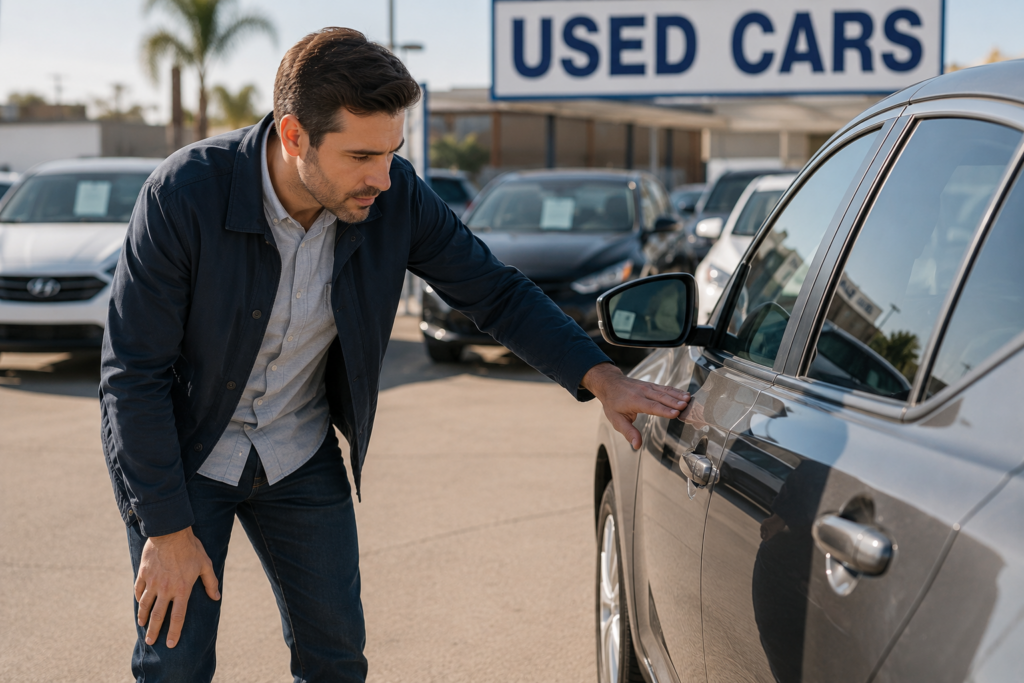
Once you’re looking at a specific vehicle, take your time with a thorough physical inspection before agreeing to anything.
Exterior: Walk around the entire vehicle in good lighting. Look for uneven panel gaps, mismatched paint, or overspray on trim pieces; all signs of prior bodywork or accident repair. Check for rust around wheel wells, door edges, and the undercarriage.
Interior: Check every button, switch, and feature. Test the air conditioning, heating, windows, locks, mirrors, and infotainment system. Look for water stains on the headliner or carpet, which can indicate a flood-damaged vehicle.
Under the hood: Look for oil leaks around the engine, corrosion on battery terminals, the condition of belts and hoses, and the color and level of all fluids. Dark, sludgy oil suggests neglected maintenance. Milky or foamy oil can indicate a head gasket issue.
Under the vehicle: If you can get a look underneath, check for rust on the frame, signs of fluid leaks, and the condition of the exhaust system.
Step 5: Take It on a Proper Test Drive
A short loop around the block isn’t a test drive. To properly evaluate a used car, you need at least 20–30 minutes of varied driving: city streets, highway speeds, and ideally some stop-and-go traffic.
During the test drive, pay attention to:
Acceleration: Does the engine respond smoothly? Any hesitation, surging, or unusual noises under acceleration?
Braking: Does the car stop confidently and in a straight line? Any pulsing, pulling, squealing, or grinding?
Steering: Does the wheel feel responsive and return to center naturally? Any looseness, vibration, or pulling to one side?
Transmission: Do gear changes feel smooth and timely? Any slipping, shuddering, or delayed engagement?
Ride quality: Does the suspension feel controlled, or does the car bounce excessively over bumps? Any clunking or rattling from underneath?
Noises: Turn off the radio and listen carefully. Unusual noises are almost always trying to tell you something.
If anything feels off during the test drive, pay attention to that instinct.
Step 6: Get an Independent Pre-Purchase Inspection
This is the single most important step that most buyers skip, and the one that saves the most money.
Before committing to any used car purchase, have it inspected by an independent mechanic who has no relationship with the seller. A thorough pre-purchase inspection typically costs $100–$200 and can reveal mechanical issues that aren’t visible to the untrained eye: worn suspension components, early transmission problems, cooling system leaks, and more.
A good mechanic will put the car on a lift, check all major systems, and give you an honest assessment of the vehicle’s condition and any repairs it’s likely to need in the near term. That information is invaluable for deciding whether to buy and what to pay.
You can find a trusted independent mechanic near you using RepairPal’s shop locator.
If a seller refuses to allow a pre-purchase inspection, walk away. That refusal tells you everything you need to know.
Step 7: Negotiate Smartly
Armed with market value data, the vehicle history report, and the pre-purchase inspection results, you’re in a strong negotiating position.
A few principles to keep in mind:
Everything is negotiable. The listed price is a starting point, not a final offer. Dealerships especially have room to move on price, financing terms, and extras.
Use inspection findings as leverage. If the pre-purchase inspection revealed issues that need addressing, factor the repair cost into your offer. Either ask the seller to fix the problems before sale or reduce the price accordingly.
Don’t be afraid to walk away. The willingness to walk away is your most powerful negotiating tool. There will always be another car.
Watch out for add-ons. Dealerships often add products and fees to the final paperwork — paint protection, fabric protection, documentation fees, and others. Review everything line by line before signing.
Step 8: Protect Your Purchase After You Buy
Even a thoroughly vetted used car can develop mechanical problems over time. Manufacturer warranties on used vehicles are often expired or close to expiring, leaving you responsible for the full cost of repairs when something goes wrong.
A vehicle service contract from Complete Auto Protect can protect you against major mechanical breakdowns – covering components like your engine, transmission, AC and heating, electrical systems, high-tech electronics, AWD components, and much more – so that an unexpected repair doesn’t undo the smart financial decision you made when you bought used.
Coverage is flexible, customizable to your needs, and valid at any ASE-certified shop or dealership. Optional add-ons like a deductible-free option and tire and rim coverage let you tailor your protection further.
Get a free quote from Complete Auto Protect today.
Buy Smart, Drive Confidently
Buying a used car without getting burned comes down to preparation, patience, and process. Do your research, check the history, inspect the vehicle, get it looked at by a mechanic you trust, and negotiate from a position of knowledge.
Follow these steps and you’ll be in the driver’s seat, in every sense of the word.