
It’s a question that comes up constantly among car owners, and the answer surprises a lot of people: standard car insurance does not cover mechanical breakdowns.
If your engine fails, your transmission gives out, or your air conditioning stops working, your auto insurance policy won’t pay for those repairs. Not even close. Car insurance and mechanical breakdown coverage are two entirely separate things, and understanding the difference could save you from a very expensive surprise.
Here’s how it all breaks down.
What Car Insurance Actually Covers
Auto insurance is designed to protect you against sudden, unexpected events, not mechanical failures that develop over time. A standard auto insurance policy typically covers:
Collision damage: Repairs to your vehicle resulting from an accident with another vehicle or object.
Comprehensive damage: Damage caused by events outside of a collision: theft, vandalism, fire, flooding, hail, and other environmental events.
Liability: Costs associated with damage or injuries you cause to others in an accident.
Medical payments / Personal injury protection: Medical expenses for you and your passengers following an accident.
Uninsured/underinsured motorist coverage: Protection if you’re hit by a driver with insufficient or no insurance.
Notice what’s missing from that list: anything related to how your car runs. Engine wear, transmission failure, electrical problems, cooling system breakdowns: none of these fall under the umbrella of standard auto insurance. They’re considered mechanical issues, not covered events.
Why the Confusion Exists
The confusion between auto insurance and mechanical breakdown coverage is understandable. Both involve your car, both involve paying a monthly or annual premium, and both involve filing a claim when something goes wrong. But the parallel ends there.
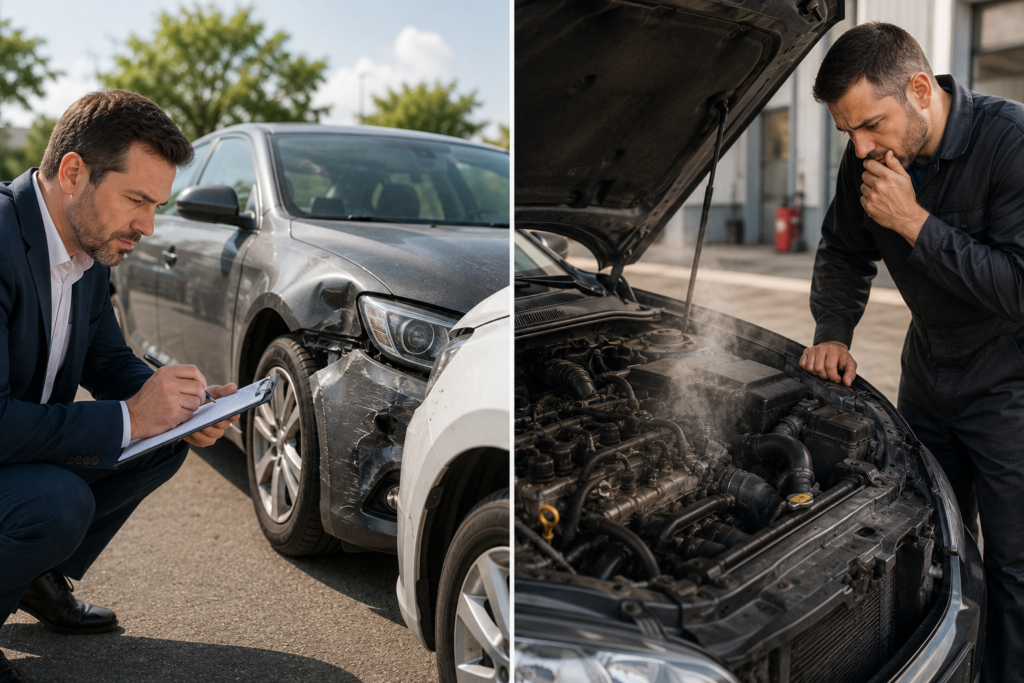
Think of it this way: auto insurance covers what happens to your car from the outside. A mechanical breakdown plan covers what happens to your car from the inside.
An accident that crushes your fender is an insurance claim. An engine that seizes because of a failed oil pump is a mechanical breakdown, and without separate coverage, that repair bill is entirely your responsibility.
What About Mechanical Breakdown Insurance?
There is a product called Mechanical Breakdown Insurance, or MBI, that some auto insurers offer as an add-on. It’s worth knowing about, though it comes with significant limitations.
MBI is typically only available for new or nearly new vehicles; often those under a certain age and mileage threshold. It’s designed to bridge the gap between a manufacturer’s warranty and extended coverage, but it generally isn’t available for older or higher-mileage vehicles. Coverage terms and availability vary significantly between insurers.
If your vehicle is relatively new and your insurer offers MBI, it may be worth exploring. But for most drivers with vehicles past the manufacturer warranty period, MBI either isn’t available or isn’t competitive with a dedicated vehicle service contract.
What Does Cover Mechanical Breakdowns?
There are two primary sources of protection against mechanical breakdown costs:
1. Manufacturer’s Warranty
When you buy a new vehicle, it comes with a manufacturer’s warranty that covers defects and mechanical failures for a set period: typically three years or 36,000 miles for a basic warranty, and five years or 60,000 miles for powertrain coverage, though this varies by manufacturer.
Once that warranty expires, you’re on your own… unless you have additional coverage in place.
2. Extended Warranty / Vehicle Service Contract
A vehicle service contract, commonly called an extended warranty, picks up where your manufacturer’s warranty leaves off. It covers mechanical breakdowns to specified components, pays the repair shop directly, and leaves you responsible only for your deductible.
This is the most comprehensive and widely available option for drivers whose manufacturer warranty has expired or is approaching its end.
The Real Cost of Going Without Coverage
To understand why mechanical breakdown coverage matters, consider what a major repair actually costs without it. According to RepairPal’s repair cost estimator, here are some of the most common major repairs and their typical price ranges:
Engine repair or replacement: $3,000–$8,000+ Transmission replacement: $2,500–$5,000+ AC compressor replacement: $800–$1,500 Electrical system repair: $500–$2,000+ Turbocharger replacement: $1,500–$4,000 Suspension repair: $1,000–$3,500
These aren’t rare, catastrophic events; they’re the kind of repairs that happen to everyday drivers every day. And without a manufacturer’s warranty or a vehicle service contract in place, every dollar of that bill comes out of your pocket.
What Happens If My Car Breaks Down After an Accident?
This is a scenario worth understanding. If your vehicle is damaged in a covered accident and that damage leads to a mechanical failure – say, a collision that damages your engine – the mechanical repair may be covered under your collision insurance because the damage was accident-related rather than the result of normal mechanical wear.
However, if your engine was already failing before the accident, or if the mechanical issue is unrelated to the collision damage, your auto insurance won’t cover it. The line between accident-related damage and pre-existing mechanical failure can be a source of disputes, which is another reason having dedicated mechanical breakdown coverage is valuable.
Don’t Assume Your Policy Covers More Than It Does
One of the most expensive assumptions a car owner can make is believing that their auto insurance will handle whatever comes their way. It won’t – and finding that out after a $4,000 repair bill is a difficult lesson.
Read your policy carefully and understand exactly what it covers. If mechanical breakdown coverage isn’t part of your current protection – and for most drivers, it isn’t – a vehicle service contract is worth serious consideration.
How Complete Auto Protect Can Help
At Complete Auto Protect, our extended warranty plans are designed to cover exactly what your auto insurance doesn’t: major mechanical breakdowns to your engine, transmission, AC and heating, electrical systems, high-tech electronics, AWD components, turbocharger, and much more.
Coverage is flexible, customizable to your needs, and valid at any ASE-certified shop or dealership. Optional add-ons including a deductible-free option and tire and rim coverage allow you to tailor your protection further.
When something goes wrong under the hood, you’ll know exactly where to turn.
Get a free quote from Complete Auto Protect today.
The Bottom Line
Car insurance protects you from the unexpected events that happen around your car. A vehicle service contract protects you from the mechanical failures that happen inside it. They serve completely different purposes — and for most drivers, having both in place is the smartest approach to total vehicle protection.
Don’t wait until you’re facing a repair bill to find out which one you’re missing.