
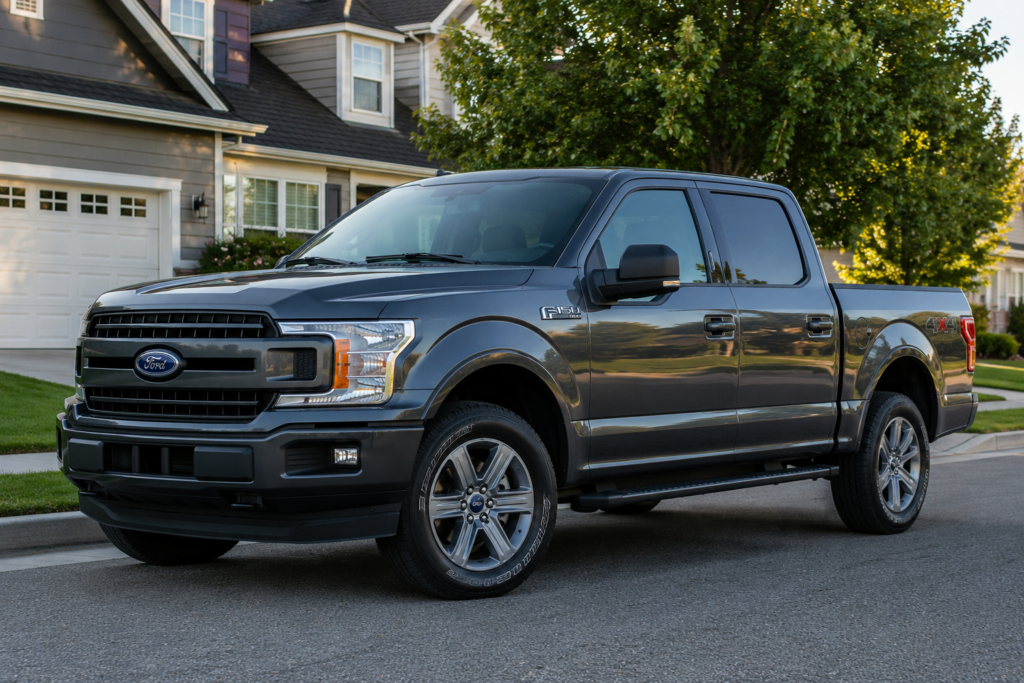
The Ford F-150 is the best-selling vehicle in America, and has been for over four decades. That’s not a coincidence. It’s a capable, versatile, and well-built truck that millions of Americans depend on for work, family, and everything in between.
But like any vehicle, the F-150 has its weak points. And while many owners get well past 100,000 miles without major issues, that mileage milestone is often when certain problems start to surface. If you own a high-mileage F-150, or are considering buying a used one, knowing what to watch for can save you significant money and frustration.
Here’s what F-150 owners commonly encounter after the 100,000-mile mark.
1. Spark Plug Issues (2004–2008 5.4L Triton V8)
This is one of the most notorious F-150 problems ever documented. The 2004–2008 models equipped with the 5.4-liter Triton V8 engine used two-piece spark plugs that were prone to breaking off inside the cylinder head during removal, leaving mechanics with a costly and labor-intensive extraction job.
Even on trucks that escape the broken plug issue, spark plugs on these engines are known to seize into the cylinder head over time, making routine maintenance far more difficult and expensive than it should be.
What to watch for: Misfires, rough idling, and reduced fuel economy; all signs that spark plugs may need attention. On affected model years, budget for a higher-than-normal plug replacement cost.
2. EcoBoost Engine Problems (2011–2019 3.5L and 2.7L Models)
Ford’s EcoBoost turbocharged engines transformed the F-150’s performance and fuel economy, but early versions came with their share of problems. Owners of 2011–2014 models reported issues including carbon buildup on intake valves (a common issue with direct injection engines), intercooler condensation leading to rough running in cold weather, and timing chain wear on higher-mileage examples.
The 2.7L EcoBoost, introduced in 2015, also saw reports of oil consumption and coolant leaks on earlier examples. Ford made significant improvements to both engines in subsequent model years, but trucks from the early EcoBoost era warrant extra scrutiny at high mileage.
What to watch for: Rough running in cold weather, hesitation under acceleration, oil consumption between changes, and any coolant loss.
3. Transmission Problems (6-Speed and 10-Speed Automatics)
Transmission complaints have followed the F-150 across multiple generations. The 6-speed automatic used in earlier models drew complaints about rough shifting, shuddering, and delayed engagement – issues that often worsen with age and mileage. Ford issued technical service bulletins addressing some of these concerns, but many owners continued to experience problems.
The 10-speed automatic introduced in 2017 also attracted criticism early on, with owners reporting hard shifts, hesitation, and hunting between gears. Software updates addressed some of these issues, but higher-mileage examples may still exhibit erratic shift behavior.
What to watch for: Rough or delayed gear changes, shuddering during acceleration, slipping between gears, or unusual noises when shifting.
4. Aluminum Body Panel Corrosion and Repair Costs
In 2015, Ford made a bold move by switching the F-150’s body panels from steel to military-grade aluminum alloy. The change reduced weight significantly and improved fuel economy, but it also introduced new ownership considerations.
Aluminum doesn’t rust the way steel does, but it is prone to corrosion when it comes into contact with dissimilar metals – a condition called galvanic corrosion. More importantly, aluminum body repair is significantly more expensive than steel repair. A dent that might cost a few hundred dollars to fix on a steel truck can run two to three times that on an aluminum-bodied F-150, and not all body shops are equipped to handle it properly.
What to watch for: Corrosion around areas where aluminum meets steel components, and any signs of improper prior repairs that could compound future issues.
5. Coolant Leaks (5.4L and EcoBoost Engines)
Coolant leaks are a recurring complaint across multiple F-150 generations. On the 5.4L Triton engine, the intake manifold gaskets are a common failure point at higher mileage. On EcoBoost models, coolant can leak from the degas bottle, coolant hoses, or in more serious cases, from a failing head gasket.
Left unaddressed, coolant leaks can lead to overheating and serious engine damage – making this one of the more important issues to catch early.
What to watch for: A sweet smell from the engine bay, a dropping coolant level, white smoke from the exhaust, or an overheating warning on the dashboard.
6. Rear Axle Seal Leaks
Rear axle seal leaks are a common maintenance item on high-mileage F-150s, particularly on four-wheel drive models. When the seals wear out, differential fluid can leak onto the brake components – causing reduced braking performance and potentially expensive brake damage if ignored.
This is a relatively affordable fix when caught early, but the consequences of ignoring it can escalate quickly.
What to watch for: An oily residue around the rear axle or wheel wells, reduced braking performance, or a burning smell coming from the rear of the truck.
7. Fuel System Issues (Direct Injection Carbon Buildup)
As mentioned with the EcoBoost engines, direct injection technology, while efficient, doesn’t allow fuel to wash over the intake valves the way traditional port injection does. Over time, carbon deposits build up on the valves, restricting airflow and reducing engine performance.
This is a known maintenance item on high-mileage EcoBoost F-150s and typically requires an intake cleaning service, either walnut blasting or chemical cleaning, every 60,000 to 80,000 miles or so.
What to watch for: Rough idling, hesitation at low RPMs, reduced power, and decreased fuel economy.
8. Power Running Board Failures (2015–Present)
Ford’s optional power running boards – the retractable steps that deploy automatically when you open a door – are a popular feature on newer F-150s, but they’re also a known point of failure. Motors, sensors, and the mechanical components of the running board system can fail over time, leaving the boards stuck in the deployed or retracted position.
Repairs can be surprisingly expensive given the labor involved in accessing the components. It’s a minor issue compared to the engine and transmission concerns above, but worth knowing about on trucks so equipped.
What to watch for: Running boards that don’t deploy or retract fully, grinding noises during operation, or error messages related to the running board system.
9. Thermostat and Cooling System Failures
Thermostat failures are a common high-mileage issue across the F-150 lineup. A failing thermostat can cause the engine to run too cold – reducing efficiency and potentially triggering a check engine light – or too hot, risking overheating damage. The cooling system more broadly, including the water pump and radiator hoses, should be inspected carefully on any F-150 approaching or past 100,000 miles.
What to watch for: Temperature gauge reading unusually high or low, a check engine light with temperature-related codes, or visible coolant leaks.
Which F-150 Model Years Hold Up Best Past 100,000 Miles?
Not all F-150 generations age equally. Here’s a quick guide:
Approach with caution: 2004–2008 (spark plug issues on 5.4L), 2011–2013 (early EcoBoost teething problems), 2017–2018 (early 10-speed transmission complaints).
Generally strong: 2009–2010 (refined 5.4L, fewer issues), 2015–2016 (EcoBoost improvements, pre-10-speed), 2019–present (more refined powertrains, software updates addressed many early complaints).
What High Mileage Really Means for Your Wallet
A well-maintained F-150 can last 200,000 miles or more. But getting there requires staying on top of the issues above and accepting that some repairs, particularly on the EcoBoost engine and aluminum body panels, will cost more than comparable work on other trucks.
The good news is that most of the problems outlined here are manageable when caught early. The expensive scenarios happen when warning signs are ignored.
Protect Your F-150 With Complete Auto Protect
Past 100,000 miles, your F-150’s manufacturer warranty is long gone. That’s exactly when an unexpected repair – a transmission rebuild, a coolant leak that leads to engine damage, or an EcoBoost issue – can hit hardest.
A vehicle service contract from Complete Auto Protect can cover major mechanical failures so you’re not facing those bills alone. If your truck has been reliable, let’s keep it that way.
Get a free quote for your Ford F-150 today.
A Great Truck Gets Even Better With the Right Maintenance
The F-150 earned its reputation for a reason. With attentive ownership and an awareness of its known weak spots, most owners get decades of dependable service from their trucks. Know what to watch for, stay ahead of the maintenance, and make sure you have coverage in place when something significant does go wrong.