
Few things create instant anxiety for a driver quite like the check engine light. One moment you’re going about your day, and the next that small amber glow on your dashboard is demanding your attention and your imagination starts running through worst-case scenarios.
Here’s the truth: the check engine light doesn’t always mean something catastrophic. But it never means nothing. Knowing how to respond, and what the light might be telling you, can save you from unnecessary panic on one end and an expensive repair on the other.
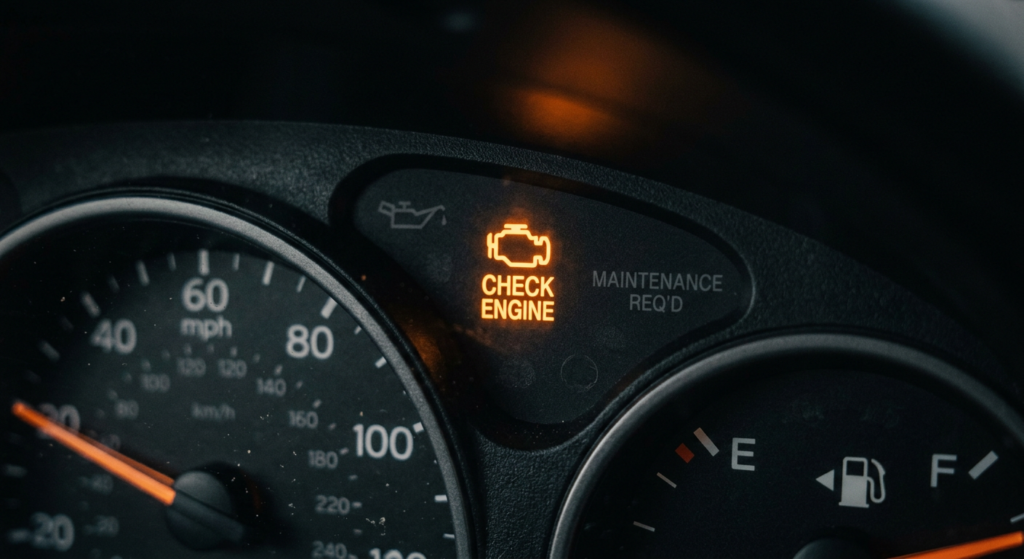
What Is the Check Engine Light?
The check engine light is part of your car’s onboard diagnostics system, known as OBD-II. This system continuously monitors dozens of sensors throughout your vehicle, covering everything from the engine and transmission to the exhaust system and fuel delivery. When one of those sensors detects a reading outside of normal parameters, it stores a diagnostic trouble code and triggers the check engine light.
The light itself doesn’t tell you what’s wrong. It just tells you that something has been flagged. To find out what, you need to read the stored code.
Steady Light vs. Flashing Light
The first thing to pay attention to is whether the light is steady or flashing.
A steady check engine light means the issue has been detected but isn’t immediately critical. You should still get it diagnosed soon, within a few days, but you don’t necessarily need to pull over immediately.
A flashing or blinking check engine light is a different story. This typically indicates an active engine misfire that could damage your catalytic converter if ignored. A flashing light means you should reduce your speed, avoid heavy acceleration, and get to a mechanic as soon as possible – ideally the same day.
Step 1: Don’t Panic
The check engine light covers an enormous range of potential issues, from something as minor as a loose gas cap to something as serious as a failing catalytic converter. Most of the time, the cause turns out to be something manageable.
Take a breath, pay attention to how your car is behaving, and follow the steps below.
Step 2: Check for Obvious Symptoms
While you’re still driving, take note of how your car feels. Ask yourself:
- Is the car running differently than normal?
- Do you notice any unusual noises: knocking, rattling, or hissing?
- Is the car hesitating, misfiring, or losing power?
- Are there any other warning lights on alongside the check engine light?
- Do you smell anything unusual: burning oil, fuel, or something sweet?
If your car is running normally with no other symptoms, the issue may be relatively minor. If you’re noticing performance problems alongside the light, treat it with more urgency.
Step 3: Check Your Gas Cap
This sounds almost too simple, but a loose or faulty gas cap is one of the most common triggers for the check engine light. The cap seals the fuel system and maintains pressure; if it’s not fully tightened or has worn out, the system detects a leak and triggers the light.
Pull over safely, remove your gas cap, and reattach it firmly until you hear it click. If this was the cause, the light may take a day or two of normal driving to turn off on its own.
Step 4: Get the Code Read
If the gas cap wasn’t the issue, the next step is to get the diagnostic trouble code pulled from your car’s OBD-II system. This tells you exactly what triggered the light.
You have a few options:
Auto parts stores: Most major auto parts retailers – including AutoZone, O’Reilly, and Advance Auto Parts – will read your check engine codes for free. This is a quick and easy first step.
A mechanic: A professional diagnostic scan at a shop is more thorough and can often pinpoint the issue more precisely than a basic code reader. Most shops charge a diagnostic fee, though some will apply it toward the repair cost.
Your own OBD-II scanner: Inexpensive Bluetooth OBD-II readers are available for under $30 and pair with a smartphone app. If you want ongoing visibility into your car’s health, it’s a worthwhile investment.
Step 5: Understand the Code
Diagnostic trouble codes follow a standard format. Here are some of the most common ones and what they mean:
P0420 — Catalyst System Efficiency Below Threshold: Often points to a failing catalytic converter, though it can also be triggered by a faulty oxygen sensor. One of the more expensive repairs if the converter itself is the culprit.
P0300 — Random/Multiple Cylinder Misfire: Indicates the engine is misfiring, which can be caused by worn spark plugs, a faulty ignition coil, or fuel delivery issues.
P0171 / P0174 — System Too Lean: The engine is getting too much air or not enough fuel. Common causes include a dirty mass airflow sensor or a vacuum leak.
P0455 — Large Evaporative Emission Leak: Often just a loose gas cap, but can also indicate a more significant leak in the evaporative emissions system.
P0128 — Coolant Temperature Below Thermostat Regulating Temperature: Usually points to a failing thermostat, which is a relatively inexpensive fix.
A code gives you a starting point, but it doesn’t always tell the full story. A mechanic can use the code alongside a physical inspection to confirm the actual cause.
Step 6: Prioritize the Repair
Once you know what the code is, you can make an informed decision about urgency. Some issues can wait a week or two without causing further damage. Others need immediate attention.
Address promptly:
- Engine misfires
- Overheating-related codes
- Oil pressure warnings alongside the check engine light
- Anything accompanied by performance issues or unusual noises
Can typically wait a short time:
- Oxygen sensor codes with no other symptoms
- Minor evaporative emissions codes
- Loose gas cap triggers
Whatever the code, don’t make a habit of ignoring the light indefinitely. A small issue left unaddressed has a way of becoming a much larger one.
Step 7: Get It Fixed
Once you’ve had the code diagnosed, get the repair done by a trusted mechanic. Make sure you understand what’s being fixed and why before authorizing any work, and ask for a written estimate upfront.
After the repair, the mechanic will clear the code and the light should go off. If it comes back on shortly after, the underlying issue may not have been fully resolved; go back and have it looked at again.
How Much Could a Check Engine Light Repair Cost?
The range is wide, because the causes are so varied. Here’s a general idea, based on RepairPal data:
Loose or faulty gas cap: $0–$25 Oxygen sensor replacement: $150–$500 Mass airflow sensor replacement: $200–$400 Spark plugs and ignition coils: $150–$600 depending on how many need replacing Thermostat replacement: $150–$300 Catalytic converter replacement: $1,000–$2,500+ EGR valve replacement: $200–$600
As you can see, the difference between a minor cause and a major one can be thousands of dollars.
How an Extended Auto Warranty Can Help
When the check engine light leads to a diagnosis like a failing catalytic converter or a significant engine issue, the repair bill can arrive fast and hit hard. These are exactly the kinds of unexpected mechanical failures that a vehicle service contract is designed to cover.
With a Complete Auto Protect plan, major covered repairs don’t have to derail your finances. Instead of facing a $2,000 bill out of pocket, you’re responsible only for your deductible – and you can get back on the road without the financial stress.
Get a free quote from Complete Auto Protect today.
The Check Engine Light Is Your Car Talking to You
It’s easy to dread that little amber glow. But think of it as your car’s way of asking for help before something gets worse. The drivers who respond quickly, get the code read, and address the issue promptly are the ones who avoid the really expensive repairs.
Don’t ignore it. Don’t panic. Just follow the steps and make sure you have coverage in place for when the diagnosis turns out to be something significant.